
Carbon Border
Adjustment Mechanism
CBAM is a price adjustment applied to imports into the EU for designated goods based on their CO2 emissions in the production process outside the EU.

CBAM looks at the actual carbon content of imported goods instead of applying broad measures to entire countries.

Companies are reviewed based on specific factors, including the carbon content of their imports, EU Emissions Trading System (EU ETS) allowances, and carbon pricing in the country where the goods are made.

Some companies may not have to follow CBAM rules, especially if they're already part of the EU ETS system

Under CBAM, companies must buy and use certificates in their yearly reports to offset the carbon emissions linked to their imported products.
REPORT
behind CBAM?

EU-based businesses are subject to a carbon price for their operations within the EU. Imported goods are required to undergo a carbon adjustment, equivalent to the cost they would have incurred if they had been manufactured following the EU's carbon pricing regulations, specifically the Emissions Trading System (ETS).The CBAM fee is modified to reflect the extent of free allowances allocated to EU production within the industries under consideration.

To prevent double carbon pricing, if a non-EU producer can demonstrate that they have already paid a carbon price for the production of the imported goods in a third country, this amount can be subtracted from the obligations of the EU importer.
REPORT
The "reporting declarant" is the entity responsible for reporting emissions of imported goods. Typically, it's the "Importer," but other options exist based on who submits the customs declaration. Each ton of imported goods falls under the responsibility of one reporting declarant, ensuring no double reporting or omissions.

According to the Union Customs Code (UCC), the reporting declarant can be:
- The importer making a customs declaration.
- A person authorized to declare imports under Article 182(1) of the UCC.
- An indirect customs representative, under Article 18 of the - UCC, when the importer is outside the Union or as agreed under Article 32 of the CBAM Regulation.
REPORT
are in the scope of CBAM?
Each sector to be represented in 6 different sections
Cement

Iron & Steel
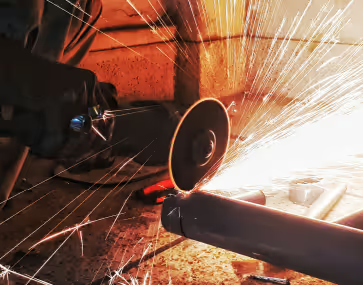
Aluminium

Fertiliser

Electricity

Hydrogen
CBAM includes in its scope certain precursors and downstream products.
The selection process for inclusion is guided by the following primary criteria: High Risk of Carbon Leakage and Significant Coverage of CO2 Emissions. In a subsequent phase, the scope of inclusion may be expanded to encompass additional sectors
REPORT
The implementation of CBAM is divided into two parts with a mechanism review between the two:

- Transitional Phase (Oct 2023 – Dec 2025)
- Review 2025: Scope Extension, Emission revision, Exports
- Post Transitional/Definitive Phase (Jan 2026 onwards)
REPORT
CBAM report containing: Total quantity of goods imported during the preceding quarter; total embedded direct and indirect emissions in those goods; the carbon price due in the country of origin for the embedded emissions; report to be submitted each quarter
Total quantity of goods imported during the preceding calendar year; total embedded emissions in those goods Emissions to be verified by EU accredited verifier; total number of CBAM certificated to be surrendered; the carbon price effectively paid in the country of origin for the embedded emissions declaration to be submitted each year

REPORT
Penalty Application:
- When the reporting declarant fails to submit a CBAM report.
- When an incorrect or incomplete CBAM report is submitted, and the reporting declarant doesn't take corrective actions when initiated by the competent authority.
REPORT
CBAM shall not apply to:
-Goods for which the Carbon Price was paid in originating third country in the form of tax, levy, fee or under the ETS system (NO DOUBLE PRICING)
- Goods imported in the customs territory which do not exceed EUR 150 per consignment (DE MINIMIS RULE)
- Goods contained in the personal luggage of travellers coming from a third country and that do not exceed EUR 150 (DE MINIMIS RULE)

REPORT
Consultancy for importers:
- Assistance in understanding CBAM Mechanism
- Assistance in gathering relevant data to complete CBAM Report
- Assistance in completing CBAM Report
Consultancy for third country producers:
- Assistance in understanding CBAM Mechanism
- Assistance in calculating CO2 emissions
- Assistance in completing CBAM template for information provision for importers
FAQs - Your questions answered
What is the CBAM mechanism and what is its purpose?
CBAM (Carbon Border Adjustment Mechanism) is the new instrument of the European Union through which imports of carbon-intensive products are monitored and taxed. Its purpose is to ensure fair competition and reduce the risk of carbon leakage.
Who is targeted by CBAM?
CBAM applies to EU importers bringing carbon-intensive goods into the internal market, as well as to producers in third countries exporting these goods to the EU.
Which products and sectors fall under CBAM?
Currently, CBAM covers highly carbon-intensive sectors: cement, iron and steel, aluminium, fertilisers, electricity, and hydrogen. The list may be extended in the future.
How does CBAM work in practice?
Importers must report the emissions embedded in the goods they bring into the EU and purchase CBAM certificates corresponding to the emission levels, reflecting the carbon price paid by EU producers.
What is the link between CBAM and the EU ETS?
CBAM complements the EU ETS (Emission Trading System). While the EU ETS applies to companies within the EU, CBAM applies to imports, ensuring a level playing field.
How does CBAM affect non-EU countries?
Third countries exporting to the EU must provide data on the emissions embedded in their products and cover the cost of CBAM certificates, unless they already have equivalent carbon pricing policies.
Who is responsible for declaring CBAM goods?
Authorized EU importers are required to declare the quantities of CBAM goods and their associated emissions.
What does the transitional phase involve and what will happen in the definitive phase?
During the transition (2023–2025), importers only report emissions without paying certificates. From 2026 onwards, reporting will be accompanied by the purchase of CBAM certificates.
What is the difference between quarterly reports and the annual CBAM declaration?
Quarterly reports focus on monitoring and transparency, while the annual declaration sets the final obligation for CBAM certificates.
What penalties apply in case of non-compliance?
Failure to declare CBAM goods correctly or on time, as well as missing certificates, results in significant financial penalties and may lead to the suspension of the import authorization.

